
- September 23, 2025
- Blog
- rishabhrusia7
- 0 Comments
Acids, bases, and salts are all around us, in the food we eat, the cleaning products we use, and even in our own bodies! But what exactly are they, and how do they behave? Understanding these substances is not only important for science class but also helps us see the chemistry in everyday life. In this guide, we’ll explore the properties of acids, bases, and salts, their common reactions, how to measure their strength with pH and indicators, and even their uses at home. With simple explanations and everyday examples, learning about acids, bases, and salts has never been easier—or more fun!
Properties of Acids and Bases
Acids and bases are everywhere in daily life — from the citrus fruit you eat to the soap you use. Their physical and chemical properties help us identify and understand how they behave.
Physical properties of acids
- Taste: Acids generally taste sour (like lemon juice, vinegar).
- Litmus test: They turn blue litmus paper red.
- Conductivity: Most acids conduct electricity in solution because they release ions.
- Corrosive nature: Strong acids like hydrochloric acid (HCl) and sulfuric acid (H₂SO₄) are corrosive and can damage skin, metals, and fabrics.
- State in nature: Some are liquids (HCl), some are solids (citric acid), and others are gases (HCl gas).
Physical properties of bases
- Taste and feel: Bases usually taste bitter and feel soapy or slippery.
- Litmus test: They turn red litmus paper blue.
- Conductivity: Like acids, bases also conduct electricity in aqueous solution.
- Corrosive nature: Strong bases such as sodium hydroxide (NaOH) and potassium hydroxide (KOH) can burn skin and are harmful.
- Appearance: Many bases are crystalline solids (like washing soda, Na₂CO₃).
Chemical properties of acids
- Reaction with metals: Acids react with metals to form salt and hydrogen gas.
Example: Zn + H₂SO₄ → ZnSO₄ + H₂↑ - Reaction with carbonates/bicarbonates: Acids release carbon dioxide gas when they react with carbonates or bicarbonates.
Example: HCl + NaHCO₃ → NaCl + H₂O + CO₂↑ - Neutralization with bases: Acids neutralize bases to produce salt and water.
Example: HCl + NaOH → NaCl + H₂O - Effect on indicators: Acids change the color of indicators such as phenolphthalein (colorless) and methyl orange (red).
Chemical properties of bases
- Reaction with acids: Bases react with acids in a neutralization reaction, producing salt and water.
Example: NaOH + HCl → NaCl + H₂O - Reaction with non-metal oxides: Bases react with acidic oxides like CO₂ to form salts.
Example: Ca(OH)₂ + CO₂ → CaCO₃ + H₂O - Reaction with certain metals: Some bases react with amphoteric metals (like aluminium and zinc) to produce hydrogen gas.
Example: 2NaOH + 2Al + 2H₂O → 2NaAlO₂ + 3H₂↑ - Effect on indicators: Bases turn phenolphthalein pink and methyl orange yellow.
What are Salts and How are They Formed?
Salts are one of the most important groups of compounds in chemistry. From the table salt we eat to the baking soda in our kitchens, salts are everywhere. A salt is a substance formed when an acid reacts with a base. They are generally ionic compounds made of a positive ion (cation) and a negative ion (anion).
Neutralization reaction
- Salts are usually formed through a neutralization reaction between an acid and a base.
- In this reaction, the hydrogen ions (H⁺) of the acid combine with hydroxide ions (OH⁻) of the base to form water, while the remaining ions form a salt.
General reaction:
Acid + Base → Salt + Water
Example:
HCl + NaOH → NaCl + H₂O
Here, hydrochloric acid reacts with sodium hydroxide to produce sodium chloride (common salt) and water.
Types of salts
- Normal salts – formed by the complete neutralization of an acid and a base.
- Example: NaCl (sodium chloride).
- Acidic salts – formed when a strong acid reacts with a weak base, or when only partial neutralization occurs.
- Example: NaHSO₄ (sodium bisulfate).
- Basic salts – formed when a strong base reacts with a weak acid, or by partial neutralization of a base.
- Example: Zn(OH)Cl (zinc hydroxide chloride).
- Double salts – formed by the combination of two different salts, crystallized together.
- Example: Mohr’s salt [FeSO₄·(NH₄)₂SO₄·6H₂O].
- Complex salts – contain a complex ion in their structure.
- Example: K₄[Fe(CN)₆] (potassium ferrocyanide).
Everyday examples of salts
Salts are not limited to chemistry labs; they play an important role in daily life:
- Sodium chloride (NaCl): Common table salt used in food and preservation.
- Baking soda (NaHCO₃): Used in baking, fire extinguishers, and cleaning.
- Washing soda (Na₂CO₃·10H₂O): Used in laundry, glass-making, and water softening.
- Plaster of Paris (CaSO₄·½H₂O): Used in construction, sculptures, and medical casts.
- Epsom salt (MgSO₄·7H₂O): Used in medicine and gardening.
Difference between Acid, Base and Salt
By taste and feel
- Acids: Acids usually taste sour. For example, lemon juice or vinegar. They feel watery when touched.
- Bases: Bases taste bitter and feel slippery or soapy. For example, soap solution or baking soda solution.
- Salts: Salts can taste salty, sweet, or neutral, depending on the type. They are usually solid and crystalline.
By chemical reaction
- Acids: React with metals to produce hydrogen gas, with bases to form salt and water.
- Example: Zn + 2HCl → ZnCl₂ + H₂↑
- Bases: React with acids to neutralize them, forming salt and water.
- Example: NaOH + HCl → NaCl + H₂O
- Salts: Formed when an acid reacts with a base (neutralization). Salts are generally neutral, but some can be slightly acidic or basic.
By examples
- Acids: Hydrochloric acid (HCl), Sulfuric acid (H₂SO₄), Acetic acid (CH₃COOH)
- Bases: Sodium hydroxide (NaOH), Calcium hydroxide (Ca(OH)₂), Ammonium hydroxide (NH₄OH)
- Salts: Sodium chloride (NaCl), Potassium sulfate (K₂SO₄), Calcium carbonate (CaCO₃)
Common Reactions Involving Acids and Bases
Reaction of acids with metals
- What happens: Acids react with certain metals to produce a salt and hydrogen gas.
- Example: Zinc reacts with hydrochloric acid: Zn+2HCl→ZnCl2+H2↑Zn + 2HCl → ZnCl₂ + H₂↑Zn+2HCl→ZnCl2+H2↑
- Explanation: The hydrogen ions (H⁺) from the acid are replaced by the metal, releasing hydrogen gas.
Reaction of acids with carbonates and bicarbonates
- What happens: Acids react with carbonates (CO₃²⁻) or bicarbonates (HCO₃⁻) to produce a salt, carbon dioxide gas, and water.
- Example: Sodium bicarbonate reacts with hydrochloric acid: NaHCO3+HCl→NaCl+CO2↑+H2ONaHCO₃ + HCl → NaCl + CO₂↑ + H₂ONaHCO3+HCl→NaCl+CO2↑+H2O
- Explanation: The reaction produces bubbles of carbon dioxide gas, which you can see as fizzing.
Reaction of bases with acids
- What happens: Bases neutralize acids to form salt and water. This reaction is called a neutralization reaction.
- Example: Sodium hydroxide reacts with hydrochloric acid: NaOH+HCl→NaCl+H2ONaOH + HCl → NaCl + H₂ONaOH+HCl→NaCl+H2O
- Explanation: The acid (H⁺) and base (OH⁻) combine to form water, making the solution neutral.
Reaction of bases with non-metal oxides
- What happens: Bases react with acidic oxides of non-metals to produce salt and water.
- Example: Calcium hydroxide reacts with carbon dioxide: Ca(OH)2+CO2→CaCO3+H2OCa(OH)₂ + CO₂ → CaCO₃ + H₂OCa(OH)2+CO2→CaCO3+H2O
- Explanation: Non-metal oxides like CO₂ are acidic in nature, and when they react with bases, a solid salt (like CaCO₃) is formed along with water.
Measuring the Strength of Acid or Base Solutions
Indicators (litmus, phenolphthalein, methyl orange)
- Indicators are substances that change color to show whether a solution is acidic or basic.
- Litmus paper:
- Red in acid
- Blue in base
- Phenolphthalein:
- Colorless in acid
- Pink in base
- Methyl orange:
- Red in acid
- Yellow in base
- Key point: Indicators help quickly identify the nature of a solution in a simple and visible way.
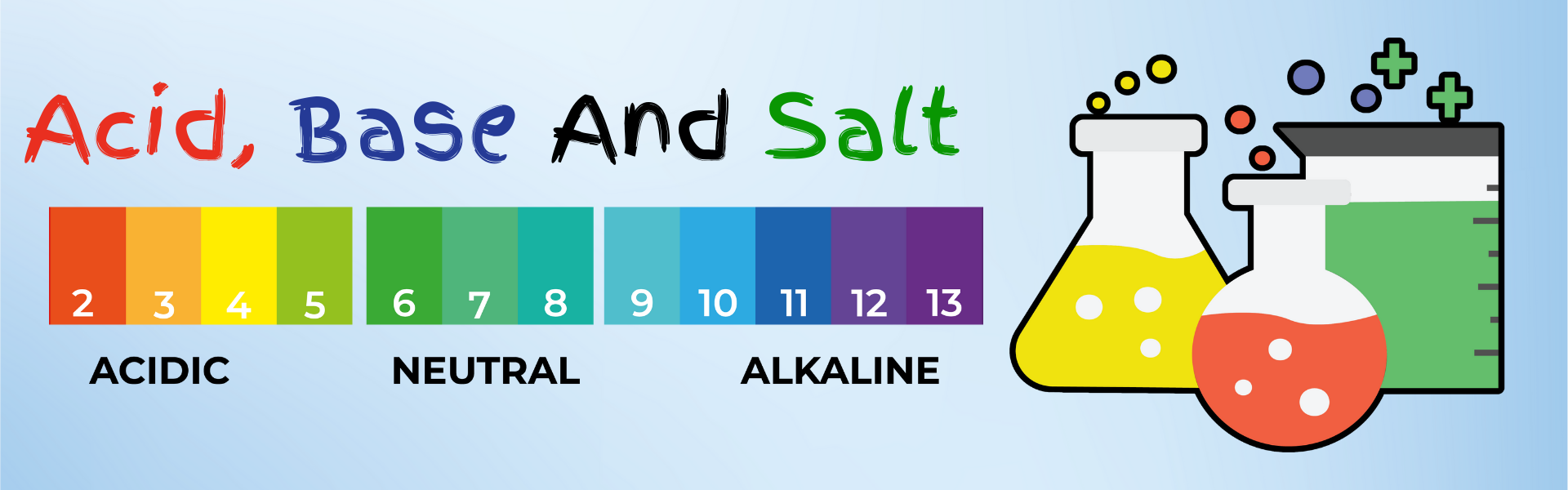
Universal indicator and pH scale
- Universal indicator shows a range of colors depending on the pH of the solution.
- pH scale: Measures how acidic or basic a solution is, from 0 to 14:
- 0–6 → Acidic
- 7 → Neutral
- 8–14 → Basic
- Example: Lemon juice (pH 2), water (pH 7), soap solution (pH 12)
Importance of pH in daily life
- pH affects many everyday things:
- Soil: Plants grow best in soils with the right pH
- Water: Safe drinking water has a neutral pH
- Health: Stomach acid and blood require proper pH for the body to function
- Swimming pools: pH must be balanced to keep water safe and clean
Common Salt
Preparation of common salt
- Common salt (sodium chloride, NaCl) can be prepared in different ways:
- Evaporation of seawater: Salt water is collected in shallow ponds and water is allowed to evaporate, leaving salt crystals.
- Mining rock salt: Salt deposits are mined from underground rocks.
- Key point: Salt obtained is purified before use in cooking and industry.
Uses of common salt
- Cooking and food preservation – adds flavor and prevents spoilage.
- Water softening – helps remove hardness from water.
- Industrial uses – used in making soap, glass, and chemicals.
- Health – necessary in small amounts for body functions.
Important compounds from common salt (baking soda, washing soda, bleaching powder)
- Baking soda (NaHCO₃):
- Used in baking, cleaning, and as an antacid for stomach acidity.
- Washing soda (Na₂CO₃·10H₂O):
- Used in cleaning agents and water softening.
- Bleaching powder (CaOCl₂):
- Used for disinfecting water and bleaching clothes.
Can acids and bases neutralize each other?
Concept of neutralization reaction
- Neutralization occurs when an acid reacts with a base to form salt and water.
- General formula: Acid+Base→Salt+WaterAcid + Base → Salt + WaterAcid+Base→Salt+Water
- Example: Hydrochloric acid reacts with sodium hydroxide: HCl+NaOH→NaCl+H2OHCl + NaOH → NaCl + H₂OHCl+NaOH→NaCl+H2O
- Key point: Neutralization reduces the harmful effects of both acids and bases, creating a solution that is closer to neutral.
Applications of neutralization in daily life
- Antacids: Medicines like baking soda neutralize excess stomach acid to relieve acidity.
- Soil treatment: Lime (Ca(OH)₂) is used to neutralize acidic soils for better crop growth.
- Waste treatment: Industrial acidic or basic waste is neutralized before disposal to prevent environmental harm.
- Cleaning products: Some cleaning agents use neutralization to remove acid or base residues safely.
Why must acids and bases be handled with care?
Harmful effects of strong acids
- Skin burns: Strong acids like H₂SO₄ or HCl can cause painful burns on skin.
- Eye damage: Even a small splash can damage eyes and cause blindness.
- Corrosion: Strong acids can corrode metals and destroy materials.
- Health hazards: Inhaling acid fumes can irritate the nose, throat, and lungs.
Harmful effects of strong bases
- Skin irritation and burns: Bases like NaOH can feel slippery but are dangerous, causing chemical burns.
- Eye injuries: Contact with eyes can lead to serious damage or blindness.
- Material damage: Strong bases can dissolve organic materials like hair, cloth, and wood.
- Respiratory problems: Breathing in base dust or fumes can irritate the respiratory system.
Frequently Asked Questions
Q1: Why do acids taste sour?
- Acids release hydrogen ions (H⁺) in water, which give them a sour taste.
- Example: Lemon juice or vinegar.
Q2: Why do bases feel slippery?
- Bases react with oils on your skin to form soap-like substances, making them feel slippery.
- Example: Soap solution or sodium hydroxide solution.
Q3: Can water be acidic or basic?
- Pure water is neutral with a pH of 7.
- Water can become acidic or basic if other substances dissolve in it.
Q4: Are all salts safe to handle?
- No. Some salts like table salt (NaCl) are safe, but others like lead salts or potassium dichromate are toxic and harmful.
Q5: Can acids and bases cancel each other’s effects?
- Yes, through neutralization, acids and bases react to form salt and water, reducing harmful effects.
Q6: Why is pH important for humans?
- Our body fluids, like blood and stomach acid, need a balanced pH to function properly.
- Incorrect pH can affect health and digestion.
Q7: How do we know if a solution is acidic or basic?
- By using indicators like litmus paper, phenolphthalein, methyl orange, or a universal indicator.
Q8: What is the difference between strong and weak acids/bases?
- Strong acids/bases fully dissociate in water, releasing more ions.
- Weak acids/bases partially dissociate, releasing fewer ions.

Leave A Comment